


3D Printing for Medical Device Prototyping: Materials, Compliance & Process
3D Printing for Medical Device Prototyping: Materials, Compliance & Process
Medical device development operates under constraints that most other industries don’t face. Every material needs to be documented. Every design decision needs to be traceable. And every prototype that goes near a clinical evaluation or verification test needs to be produced from materials with certified biocompatibility.
Professional 3D printing has become an essential tool in medical device development precisely because it can meet these requirements while delivering the speed and flexibility that modern product development demands. This guide covers the biocompatible materials available, the compliance considerations you need to be aware of, and how the prototyping process works in practice.
Why Medical Device Developers Use 3D Printing
Medical device development programmes are long, heavily regulated, and expensive. Any tool that reduces risk, accelerates iteration, and lowers the cost of validation is valuable. Professional 3D printing delivers all three:
- Speed: Functional prototypes in 3–5 working days, compared to weeks or months for machined or moulded parts. In a development programme that runs for 18–24 months, faster prototyping cycles can compress the timeline significantly.
- Material traceability: Certified biocompatible materials with documented compliance to ISO 10993 and USP Class VI. The material certifications are available and traceable, which matters when building a regulatory submission.
- Cost reduction: Multiple design iterations at a fraction of the cost of machining or soft tooling. A 3D printed prototype might cost £150–£500; a machined equivalent could be £1,000–10,000+.
- Design freedom: Complex internal features, thin walls, ergonomic surfaces, and consolidated assemblies that would be difficult or impossible to machine.
- Risk mitigation: Test and validate before committing to production tooling. If the design needs to change — and in medical devices it almost always does — the cost of change is minimal.
Biocompatible Materials for Medical 3D Printing
At Pro 3D Print, we offer two certified biocompatible FDM materials, plus additional materials that support the broader medical device development process. Each is printed on our Stratasys industrial FDM machines and is available from our medical 3D printing service.
ABS-M30i — The Medical Prototyping Workhorse
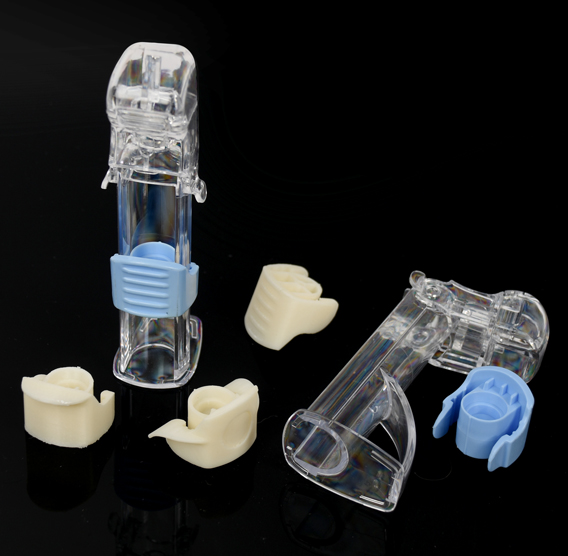
ABS-M30i is the most widely used biocompatible FDM material in medical device prototyping. It combines the familiar mechanical properties of ABS with certified biocompatibility, making it suitable for parts that contact skin, food, or medication.
- Certifications: ISO 10993 (biological evaluation of medical devices), USP Class VI (plastic biocompatibility), ISO 18562 (biocompatibility of breathing gas pathways for ventilators, breathing tubes, and resuscitators)
- Sterilisation: Gamma sterilisable and ethylene oxide (EtO) sterilisable
- Properties: Tensile strength 36 MPa, heat deflection temperature 96°C, good impact resistance
- Colour: Natural (ivory) only
Typical applications include surgical guide prototypes, diagnostic device housings, inhaler and nebuliser components, pharmaceutical tooling, drug delivery device prototyping, and patient-contact consumables.
ULTEM 1010 — The High-Performance Option
ULTEM 1010 is the highest-performing biocompatible material in the FDM range. It offers the best combination of strength, heat resistance, and chemical resistance of any printable thermoplastic, with the added capability of autoclave sterilisation.
- Certifications: ISO 10993 (biocompatibility), USP Class VI, NSF 51 (food contact)
- Sterilisation: Autoclavable (steam sterilisation at 134°C), gamma sterilisable, EtO sterilisable
- Properties: Tensile strength 81 MPa, heat deflection temperature 213°C, exceptional chemical resistance
- Colour: Natural only
ULTEM 1010 is specified where parts need to withstand autoclave sterilisation cycles, prolonged chemical exposure, or high-temperature environments. Applications include reusable surgical instruments and tool prototypes, autoclavable medical trays and holders, pharmaceutical manufacturing tooling, and composite layup tooling for medical components.
Supporting Materials for the Development Process
Not every prototype in a medical device programme needs to be biocompatible. Early-stage concept models, fit-check prototypes, and internal test fixtures can often be produced in standard materials at lower cost:
| Material | Biocompatible? | Sterilisable? | Best Medical Use | Cost Tier |
| ABS-M30i | Yes (ISO 10993) | Gamma, EtO | Patient-contact prototypes | ££ |
| ULTEM 1010 | Yes (ISO 10993) | Autoclave, Gamma, EtO | Reusable / high-temp parts | £££ |
| ABS-M30 | No | No | Early-stage concept models | £ |
| Polycarbonate | No | No | Structural test prototypes | ££ |
| Nylon 12 | No | No | Snap-fit and flexible features | ££ |
| ABS-ESD7 | No | No | Electronic subassembly jigs | ££ |
The full properties of each material are covered in our complete materials guide.
Compliance Considerations for 3D Printed Medical Prototypes
Medical device regulation in the UK is overseen by the MHRA (Medicines and Healthcare products Regulatory Agency). Devices require UKCA marking for the UK market and CE marking for the EU. The regulatory pathway directly affects how 3D printing can be used in development.
Prototypes vs Production Parts
It’s important to distinguish between two different uses of 3D printing in medical device development:
- Prototypes for design verification and validation: These are used internally to test the design, check form and fit, and evaluate function. They don’t go to market and don’t require UKCA/CE marking themselves. However, if they’re used in verification testing that forms part of the regulatory submission, the materials and processes need to be documented and traceable.
- Production parts (end-use devices): If 3D printing is the production process — patient-specific surgical guides, for example — the entire manufacturing process must be validated and controlled under a quality management system compliant with ISO 13485.
Most of the 3D printing we do for medical clients falls into the first category: prototyping and design validation, where the speed and material capability of professional FDM adds genuine value.
Key Standards to Be Aware Of
- ISO 10993 — Biological evaluation of medical devices. This family of standards defines the tests required to assess biocompatibility, including cytotoxicity, sensitisation, irritation, and systemic toxicity. ABS-M30i and ULTEM 1010 both comply with the relevant parts of this standard.
- USP Class VI — United States Pharmacopeia classification for plastics used in medical devices. Both ABS-M30i and ULTEM 1010 meet USP Class VI requirements.
- ISO 18562 — Biocompatibility of breathing gas pathways. Relevant for ventilators, breathing tubes, and respiratory devices. ABS-M30i is tested and compliant.
- ISO 13485 — Quality management systems for medical devices. Applies to the manufacturing process itself, not the material. Relevant if 3D printing is the production method.
A Note on Responsibility
It’s worth being clear: while the raw materials carry biocompatibility certifications, the finished device manufacturer is ultimately responsible for determining the suitability of all materials used in their products. The 3D printing process, post-processing, surface treatments, and assembly all contribute to the final biocompatibility of the finished part. Material certification is a starting point, not an endpoint.
This is an area where working with an experienced 3D printing service adds value. We understand what documentation medical clients need, how to maintain material traceability, and what post-processing steps are appropriate for medical applications.
Where 3D Printing Fits in the Medical Device Development Cycle
Professional 3D printing is most valuable in the early to mid stages of medical device development, where the design is still evolving and speed of iteration matters most:
| Stage | Activity | Material Required | 3D Printing Role |
| Concept | Form and ergonomics exploration | ABS-M30 (standard) | Fast, cheap concept models |
| Design Review | Fit checks, stakeholder sign-off | ABS-M30 or ABS-M30i | Physical models for review meetings |
| V&V Prototyping | Verification and validation testing | ABS-M30i or ULTEM 1010 | Functional parts in certified materials |
| User Testing | Simulated-use and usability studies | ABS-M30i | Realistic prototypes for user feedback |
| Clinical Eval | Clinical evaluation samples | ABS-M30i or ULTEM 1010 | Traceable, certified-material parts |
| Bridge Production | First units while tooling is made | ABS-M30i | Low volume, production-representative |
| Production | Volume manufacture | Injection moulding (typically) | 3D printing for jigs/fixtures only |
How Medical Prototyping Works with Pro 3D Print
The process for medical clients follows the same general workflow as any professional 3D printing project, with additional attention to material traceability and documentation:
- File submission and review. Send your CAD files (STL or STEP). We review the geometry and discuss the application, material requirements, and any compliance considerations.
- Material selection. We recommend ABS-M30i, ULTEM 1010, or a standard material depending on the stage of development and the intended use of the prototype.
- Build specification. We advise on print orientation, layer resolution, and fill density to optimise for the part’s functional requirements.
- Printing. Parts are built on our Stratasys industrial FDM machines using certified material cartridges with full lot traceability.
- Post-processing. Soluble supports are removed, surfaces are finished, and any assembly is completed. All steps are documented.
- Quality check and delivery. Parts are inspected, packaged, and shipped or collected from our Leicester workshop. Material certificates are available on request.
For medical prototyping projects, we can provide material certification documentation, batch traceability information, and process records. If you need specialist surface treatments such as antibacterial coatings, we can accommodate those too.
Common Medical Device Applications
The range of medical devices that benefit from professional 3D printing during development is broad:
- Surgical instruments and guides: Prototyping handle ergonomics, cutting interfaces, and alignment guides in biocompatible materials before committing to machining or moulding.
- Diagnostic equipment: Housings, fascia panels, and internal mounting structures for point-of-care diagnostic devices.
- Drug delivery devices: Inhalers, auto-injectors, and pen injectors where the interaction between mechanism and housing needs iterative testing.
- Patient-wearable devices: Sensors, monitors, and wearable housings where comfort, fit, and skin contact need to be evaluated.
- Respiratory devices: Ventilator components, breathing circuits, and airway management devices — ABS-M30i’s ISO 18562 compliance is specifically relevant here.
- Rehabilitation and orthotics: Custom brackets, supports, and adjustment mechanisms.
- Manufacturing tooling: Assembly jigs, inspection fixtures, and packaging inserts for medical device production lines.
Working on a Medical Device Project?
If you’re developing a medical device and need prototypes in biocompatible materials, get in touch. We’ll discuss your application, advise on material selection, and make sure the prototypes support your development and regulatory process.
We work with medical device companies, design consultancies, and university research groups across the UK. Whether you need a single concept model or a batch of verification prototypes in ABS-M30i, we can help.
➤ Request a quote | Call us on 0116 262 5737 | Email info@pro3dprint.co.uk
Related reading: Complete Materials Guide | Tolerances Guide | 3D Printing Cost Guide