What Makes 3D Printing “Professional”?
The word “professional” isn’t just marketing language. It refers to a specific level of equipment, materials, accuracy, and expertise that separates industrial 3D printing from the hobbyist and desktop market.
Professional 3D printing services typically use well-maintained, properly calibrated machines that deliver tighter tolerances and more consistent material properties than you’d usually get from a casual consumer setup. Depending on the job, parts can be built from everyday materials such as PLA and PETG, tougher options like ASA, or engineering polymers such as ABS, polycarbonate, nylon and carbon fibre composites.
But it’s not just about the hardware. A professional service also means:
- Expertise in print orientation, build parameters, and material selection to get the best result for your specific application
- Secondary processing (support removal, surface finishing, assembly, and painting) so parts arrive ready to use
- Practical extras such as threaded inserts, drilling and tapping, or UV laser marking for labels and part numbers
- Confidentiality and IP protection as standard, including NDA agreements where needed
- Engineering support to review your CAD files and flag potential issues before printing starts
At Pro 3D Print, we print in-house using FDM from our base in Leicester. We specialise in PLA, PETG and ASA, and other materials, including engineering grades such as carbon fibre nylon, polycarbonate and TPU, are available on request. We also provide secondary processing and finishing and assembly so that parts arrive ready for testing, not half-finished.
How Does FDM 3D Printing Work?
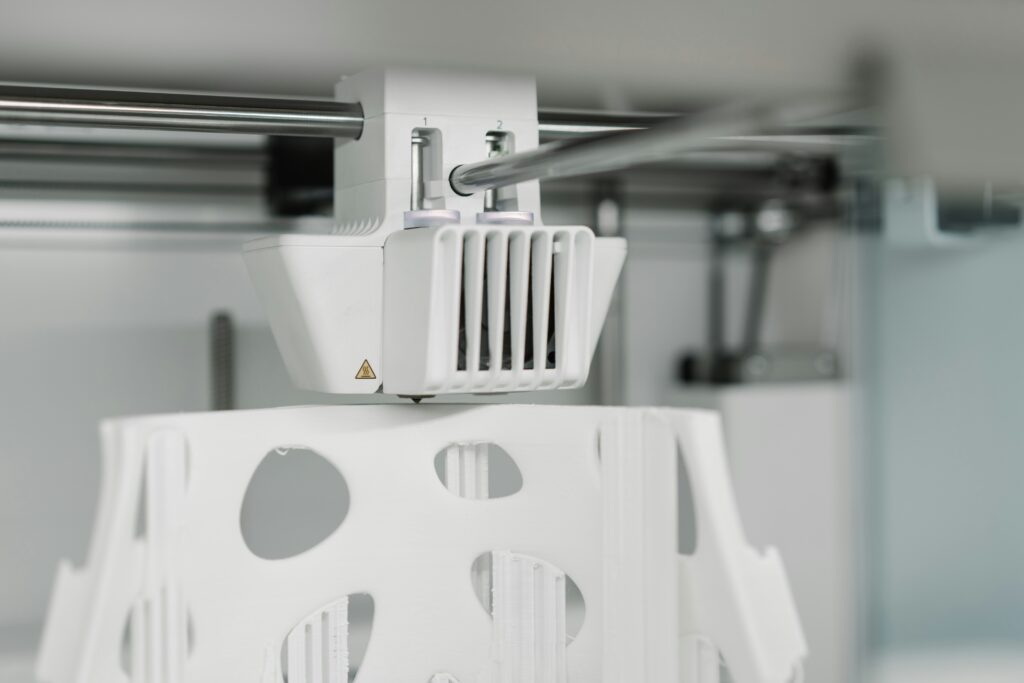
FDM (Fused Deposition Modelling) is the most widely used professional 3D printing technology. It works by extruding thermoplastic material through a heated nozzle, building parts layer by layer from the bottom up.
The process starts with a 3D CAD model, typically exported as an STL or STEP file. The file is then sliced into layers by specialist software, which also generates support structures where needed. The printer builds the part and its supports simultaneously, using a soluble or breakaway support material.
Once the print is complete, supports are removed, and the part moves on to any secondary processing that’s been specified: sanding, filling, painting, threaded inserts, laser marking, or assembly.
The key advantage of FDM at the professional level is that it prints in real thermoplastics. These aren’t UV-cured resins or sintered powders. They’re solid thermoplastics, many from the same families of polymers used in injection moulding, which means the parts behave much more like production components when you test them.
What Materials Can You Print With?
One of the biggest differences between consumer and professional 3D printing is how well the material is matched to the job. PLA and PETG are excellent everyday materials, and together with ASA they make up our standard range, available in black, white and grey as standard. Beyond those, a wider portfolio of engineering polymers can be printed with FDM, each suited to different applications.
Here’s an overview of ASA and some of the engineering materials available on request:
- ABS — A strong, general-purpose thermoplastic. Good mechanical properties and suitable for a wide range of prototyping and functional testing applications.
- PC FR — A flame-retardant polycarbonate for parts that must resist ignition, such as electrical enclosures and components near heat sources.
- ABS-GF — ABS reinforced with glass fibre for extra stiffness and dimensional stability, with less warping.
- ASA — One of our standard materials. UV-resistant and weatherable, making it a strong choice for outdoor and functional parts, and for prototypes that need to be tested in outdoor environments.
- PA6-GF — Nylon reinforced with glass fibre for toughness and rigidity at a lower cost than carbon fibre. Suited to functional and mechanical parts.
- PA6-CF — Nylon reinforced with carbon fibre for high strength, stiffness and wear resistance. Ideal for gears, tooling and load-bearing parts.
- Polycarbonate (PC) — High strength and heat resistance. A genuine engineering thermoplastic for demanding applications.
- PET-CF — PET reinforced with carbon fibre for excellent stiffness, low moisture absorption and good heat resistance.
- PAHT-CF — A high-temperature nylon with carbon fibre that keeps its strength in hot environments, such as engine bays and industrial equipment.
- TPU — A flexible elastomer for producing rubber-like parts. Useful for seals, gaskets, grips, and vibration dampening components.
- ASA-CF — ASA with carbon fibre for stiff, UV- and weather-resistant parts that hold their shape and colour outdoors.
You can see the full range on our materials page. If you’re not sure which material is right for your project, that’s something we can help with. Material selection is a core part of what we do.
What Do Manufacturers Use Professional 3D Printing For?
Professional 3D printing isn’t just about making prototypes (although that’s a big part of it). Here are the most common applications we see from manufacturers:
Rapid Prototyping
This is where most manufacturers start. You need to test fit, form, and function before committing to tooling, and professional 3D printing lets you do that in days rather than weeks. Because the parts are printed in real thermoplastics, you can run meaningful tests that give you confidence in the design before moving to production.
Design Verification
Before you invest in injection mould tooling or production processes, you need to know the design is right. 3D printed parts let you physically check dimensions, assembly interfaces, ergonomics, and aesthetics at a fraction of the cost and time of traditional prototyping methods.
Low Volume Production
For runs of 10 to a few hundred parts, 3D printing can be more cost-effective than setting up tooling. It’s also useful as a bridge manufacturing solution, producing parts for early customers or field testing while production tooling is being made.
Jigs, Fixtures & Manufacturing Tooling
Many manufacturers are now printing custom jigs and fixtures for their production lines. 3D printing lets you design tooling around the specific task rather than compromising with off-the-shelf solutions, and iterate quickly when the production process changes.
Specialist Applications
Depending on the industry, there are more specific uses, often in engineering materials available on request: medical device prototyping in our standard and engineering materials, automotive parts for under-bonnet testing, aerospace components in high-temperature engineering materials, and flame-retardant housings for electronics and industrial applications.
What to Expect from a Professional 3D Printing Service
If you haven’t used a professional 3D printing service before, here’s what the typical process looks like:
- Send your files. You provide a 3D CAD file. STL or STEP format is ideal. If you don’t have a print-ready file, a good service will offer CAD modelling support to get you there.
- Material and build discussion. The service reviews your file, advises on material selection, print orientation, and any design considerations that could affect the result.
- The part is printed. Depending on size and complexity, this might take anywhere from a few hours to a couple of days.
- Post-processing. Supports are removed, surfaces are finished, and any secondary processes (inserts, assembly, painting, laser marking) are applied.
- Parts are quality-checked and shipped. A good service should be able to turn around most jobs within 3–5 working days.
If you need to discuss a project or want to understand what’s possible, get in touch with our team. We’re happy to talk through your requirements before you commit to anything.
Professional vs Consumer 3D Printing: The Key Differences
It’s worth being clear about what separates professional 3D printing from the consumer/desktop market, because the difference is significant:
| Consumer / Desktop | Professional / Industrial | |
| Materials | PLA, PETG, basic ABS | PLA, PETG and ASA, plus engineering grades such as ABS, PC, PC FR, carbon and glass fibre nylons and TPU |
| Accuracy | ±0.5mm typical | ±0.2mm or better |
| Build Volume | Small (220×220×250mm typical) | Varies by machine; larger parts can be printed in sections and bonded |
| Post-Processing | Manual support removal | Surface finishing, painting, threaded inserts, assembly |
| Repeatability | Variable between prints | Consistent, production-grade repeatability |
| Engineering Support | None | Material advice, orientation optimisation, design review |
| Confidentiality | No formal process | File deletion after completion, NDA available |
Professional 3D Printing in Leicester and the Midlands
Leicester sits right in the heart of the UK’s manufacturing corridor. The East Midlands has a long history in engineering and manufacturing, and that’s reflected in the demand for professional prototyping and additive manufacturing services in the region.
Having a local 3D printing service means faster turnaround, easier communication, and the option to visit and discuss projects face to face. For manufacturers across Leicestershire, Nottinghamshire, Derbyshire, and the wider Midlands, working with a local partner can make a real difference to project timelines.
Pro 3D Print is based at 19 St Margaret’s Street, Leicester LE1 3EB, and ships UK-wide. We work with manufacturers, design consultancies, and product developers across the Midlands and beyond. If you’d like to talk about a project, get a quote here or call us on 0116 262 5737.
Getting Started
If you’re exploring professional 3D printing for the first time, or if you’ve been using a consumer-level service and want to step up, here’s what to do next:
- Send us your CAD files. We’ll review them and come back with material recommendations and a quote. No commitment required.
- Not sure about materials? We can advise on the best option for your application. It’s what we do every day.
- Need to understand costs? Our pricing depends on part size, material, and any post-processing required. Get in touch for a quick estimate.
➤ Ready to get started? Request a quote or call us on 0116 262 5737.